How Developers Use SmartPromptAgents to Build Apps Faster
SmartPromptAgents

The software development lifecycle is notoriously complex. While writing core business logic is satisfying, modern engineering involves massive friction. Developers spend an inordinate amount of time wrestling with boilerplate code, configuring CI/CD pipelines, hunting obscure bugs, writing tedious documentation, and managing infrastructure. This operational drag significantly slows deployment cycles and leads to widespread developer burnout.
The paradigm of software engineering is undergoing a radical transformation. The integration of artificial intelligence is moving far beyond simple code completion tools. Today, elite engineering teams utilize AI agents for business to automate entire segments of the DevOps pipeline. By deploying specialized autonomous systems, developers eliminate friction and focus entirely on high-level architecture. This article explores how modern developers leverage the SmartPromptAgents ecosystem to build, test, and ship applications faster.
1. Automating Boilerplate and Scaffolding
Starting a new project is often the most tedious phase of development. Configuring the initial repository, setting up routing, establishing database connections, and writing basic CRUD operations requires hours of repetitive typing. It is necessary work, but it provides zero unique value to the application.
Developers use SmartPromptAgents to bypass this phase entirely. By utilizing specialized prompt engineering tools, a developer can simply describe the desired application architecture in plain English. An AI scaffolding agent instantly generates the complete foundational codebase, perfectly adhering to best practices and company-specific coding standards. This allows engineers to jump straight into writing the complex, proprietary logic that actually differentiates their product in the market.
2. Autonomous Code Review and Refactoring
Code reviews are a critical component of maintaining software quality, but they are notoriously slow. Waiting for a senior engineer to manually review a pull request can stall a deployment pipeline for days. Furthermore, human reviewers often miss subtle security vulnerabilities when staring at thousands of lines of code.
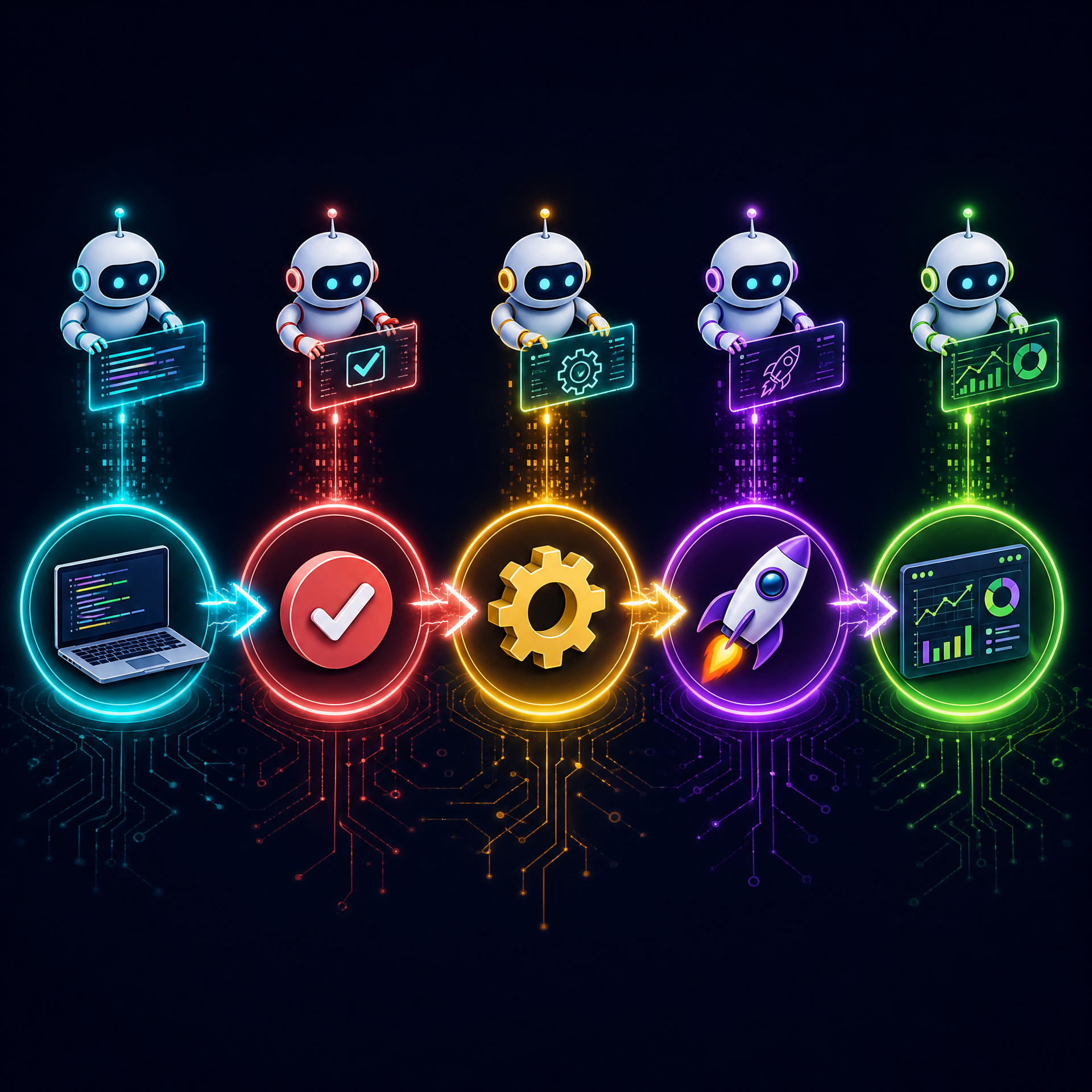
SmartPromptAgents act as autonomous, instantly available senior reviewers. When a developer submits a pull request, an AI review agent immediately analyzes the code. It checks for style guide compliance, identifies potential memory leaks, and suggests performance optimizations. If the AI detects a highly nested loop, it can autonomously refactor the code into a more efficient, readable format. This ensures that every line of code merged into the main branch is secure and highly optimized, drastically reducing technical debt.
3. Continuous Integration and Testing
Writing comprehensive unit and integration tests is the bane of many developers’ existence. It is time-consuming, repetitive, and often neglected when deadlines loom. However, deploying untested code is a guaranteed recipe for catastrophic production failures.
Through the SmartPromptAgents platform, developers deploy dedicated AI testing agents. As soon as new logic is written, the testing agent autonomously generates comprehensive test suites covering edge cases. It executes these tests in isolated environments, instantly flagging any regressions. By integrating these AI workflows directly into the CI/CD pipeline, development teams achieve 100% test coverage without manually writing a single assertion.
4. Intelligent Bug Hunting and Resolution
When an application crashes in production, the resulting scramble is stressful and expensive. Developers must parse through massive, cryptic log files, attempt to reproduce the error locally, and then blindly search for the root cause. This process can take hours or even days, resulting in unacceptable downtime.
SmartPromptAgents transform debugging from a manual hunt into an automated resolution. When an error is logged, a diagnostic AI agent instantly analyzes the stack trace. It traces the error back to the specific line of offending code, cross-references the issue against millions of known bugs, and generates a precise patch. The developer simply reviews the AI’s proposed fix and clicks merge. According to software industry analysts at Gartner, AI-assisted debugging reduces Mean Time To Resolution (MTTR) by unprecedented margins.
5. Seamless API Integration and Management
Modern applications rarely exist in isolation; they rely on dozens of third-party APIs for payments, messaging, mapping, and authentication. Integrating these APIs requires developers to read dense, poorly written documentation, manage authentication tokens, and handle complex rate-limiting logic.

Developers utilize SmartPromptAgents to handle API orchestration autonomously. If an application needs to integrate Stripe for payments, an AI integration agent instantly generates the necessary webhook handlers, secure token management, and error-handling logic. If a third-party API suddenly changes its endpoint structure, the AI agent detects the breaking change and autonomously updates the integration code. This level of resilience is a hallmark of modern AI business systems.
6. Automated Documentation Generation
Documentation is universally despised by developers. Writing clear, comprehensive guides for APIs, internal libraries, and system architecture is tedious. Consequently, documentation is almost always outdated, making onboarding new engineers incredibly difficult and slowing down cross-team collaboration.
SmartPromptAgents solve this by treating documentation as an automated byproduct of development. As a developer writes code, a dedicated documentation agent runs in the background. It analyzes the functions, classes, and endpoints, and autonomously generates beautiful, highly accurate technical documentation. When the code changes, the documentation updates instantly. This ensures that the codebase is always perfectly documented, drastically reducing the friction of scaling engineering teams.
7. Infrastructure as Code (IaC) Orchestration
Managing cloud infrastructure—provisioning servers, configuring load balancers, and managing databases—is a complex discipline that usually requires dedicated DevOps engineers. Misconfiguring a single AWS or Azure setting can result in massive security breaches or exorbitant hosting bills.
Developers leverage SmartPromptAgents to manage Infrastructure as Code (IaC) effortlessly. By simply describing the required environment (“I need a highly available Node.js cluster with a managed PostgreSQL database”), an AI DevOps agent generates the precise Terraform or Kubernetes configuration files. The agent ensures that the infrastructure is secure, scalable, and cost-optimized. This empowers frontend and backend developers to deploy complex architectures without needing deep DevOps expertise.
8. Database Schema Optimization
As an application scales, poorly designed database schemas become massive performance bottlenecks. Queries that took milliseconds with a hundred users can take seconds with a million users, resulting in unacceptable application latency.
SmartPromptAgents continuously monitor database performance in real-time. An AI database agent analyzes slow-running queries and autonomously suggests schema optimizations. It might recommend adding a specific index, restructuring a complex join, or implementing a caching layer. By proactively optimizing the data layer, these agents ensure that the application remains lightning-fast regardless of user load, a capability frequently praised by enterprise architects at Forbes.
9. Real-Time Security and Threat Mitigation
Security cannot be an afterthought in modern application development. With cyber threats becoming increasingly sophisticated, relying on manual security audits is dangerously inadequate. Developers need continuous, automated threat detection integrated directly into their workflow.
SmartPromptAgents act as an always-on security operations center. As code is written, security agents scan for common vulnerabilities like SQL injection, cross-site scripting (XSS), and insecure dependency versions. If a zero-day vulnerability is announced in a widely used open-source library, the AI agent instantly scans the entire repository, identifies the vulnerable package, and automatically generates a pull request to update it. This proactive defense mechanism is critical for enterprise compliance.
10. The Shift to High-Leverage Engineering
The ultimate benefit of utilizing SmartPromptAgents is not just speed; it is the fundamental elevation of the developer’s role. When you automate boilerplate, testing, debugging, and deployment, you remove the tedious friction that causes burnout.
Developers are no longer code monkeys; they become system architects. They spend their time designing innovative features, optimizing user experiences, and solving complex business problems. By deploying a dedicated AI staff of autonomous agents, engineering teams can achieve a level of output that previously required triple the headcount.
Accelerate Your Development Pipeline
The era of manual, friction-heavy software development is ending. The teams that embrace autonomous agent orchestration are shipping features faster, with fewer bugs, and at a fraction of the cost of their competitors. Building applications in 2026 requires more than just good developers; it requires an intelligent, automated ecosystem.

Ready to Supercharge Your Engineering Team?
Stop wasting valuable developer hours on boilerplate code, manual testing, and tedious debugging. It is time to integrate specialized autonomous agents directly into your DevOps pipeline.
Try SmartPromptIQ AI Staff free today and experience the incredible speed of AI-assisted software development.
Download 50 AI Staff workflows to see exactly how elite engineering teams are using SmartPromptAgents to automate their entire deployment lifecycle.
Explore the SmartPromptAgents Marketplace today and find the perfect AI tools to build your application faster!